Brand
Seen
Role
Creative Director
Team
Designer: Alice Chachka
Writer: Brenda Waggoner
Creative Director: Isabel Lopez
- - - - - - - - - - - - - - - - - - - - - - - - - - - - - - - - - - - - - - - - - - - - -
Overview
In 2022, Snap Finance acquired Seen (formerly Sable) as part of its broader expansion into credit-building products. Due to legal and risk considerations at the time of acquisition, Seen operated as a structurally separate sister company, with its own identity, design language, and governance model.
In 2025, executive leadership made a strategic decision: Seen would formally become a Snap Finance solution (alongside Snap Leasing and Snap Loan) positioning it as the credit card product within Snap’s growing financial ecosystem.
This shift required more than a visual update. It demanded a redefinition of brand architecture within a highly regulated fintech environment.
I am leading this transition.
The strategic challenge
We faced three critical constraints:
• Legal & risk history: Seen had previously been separated from Snap to mitigate liability exposure.
• Operational complexity: The Seen brand is registered with Mastercard, making renaming impractical.
• Visual divergence: Seen’s identity system had evolved independently, resulting in minimal cohesion with Snap’s brand language.
At the same time, Snap’s long-term strategy centered around building a unified financial ecosystem to support underserved consumers in building and strengthening credit.
The architecture needed to signal cohesion without erasing Seen’s equity or disrupting regulatory approvals.
Architecture strategy: hybrid model
Rather than collapsing Seen into Snap (branded house) or maintaining full separation (house of brands), I defined a hybrid architecture model:
• Seen remains the product name
• Positioned consistently as “a Snap Finance solution”
• Strategic visual bridges implemented across brand systems
• Governance model established for cross-functional alignment
This approach preserves regulatory stability while strengthening ecosystem clarity.

Visual system evolution
The first phase of implementation focuses on visual alignment.
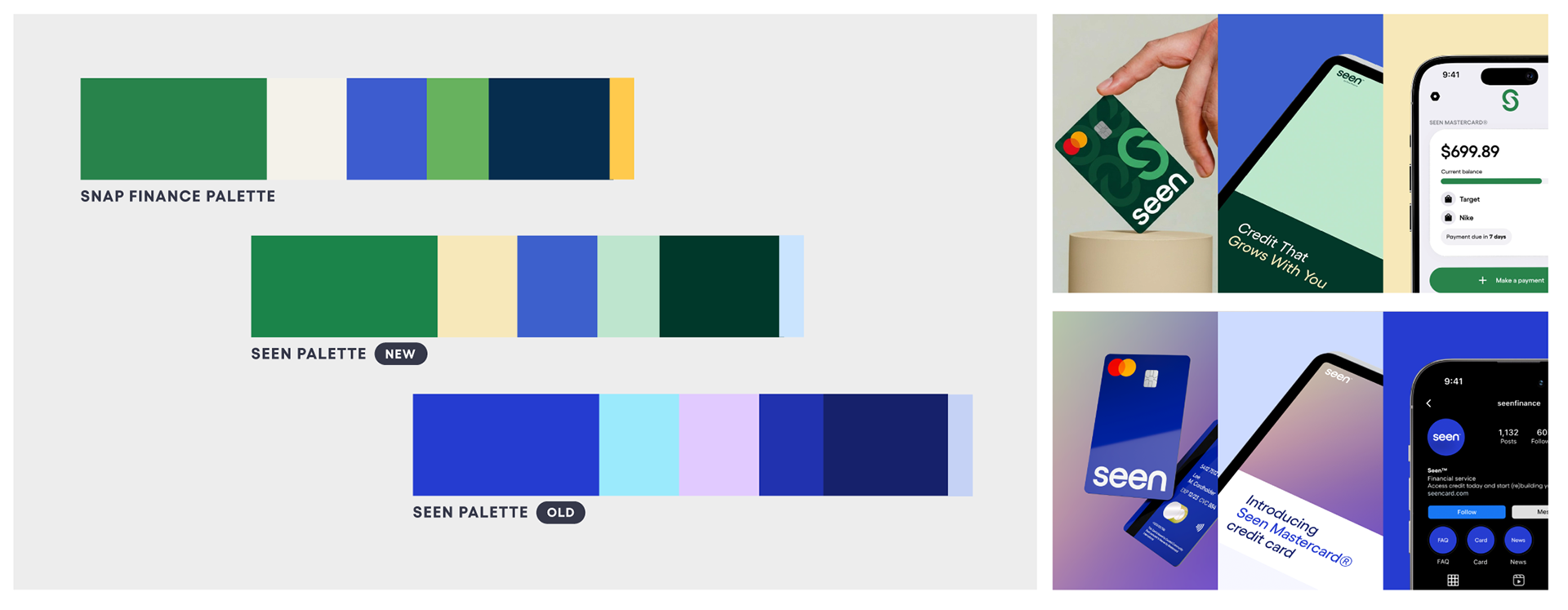
Palette bridge strategy
• Introduced Snap’s green as a connective visual element within Seen materials
• Refined secondary palette to reduce visual distance between brands
• Maintained enough differentiation to preserve product identity
The first phase of implementation focuses on visual alignment.
Palette bridge strategy
• Introduced Snap’s green as a connective visual element within Seen materials
• Refined secondary palette to reduce visual distance between brands
• Maintained enough differentiation to preserve product identity
Card art evolution
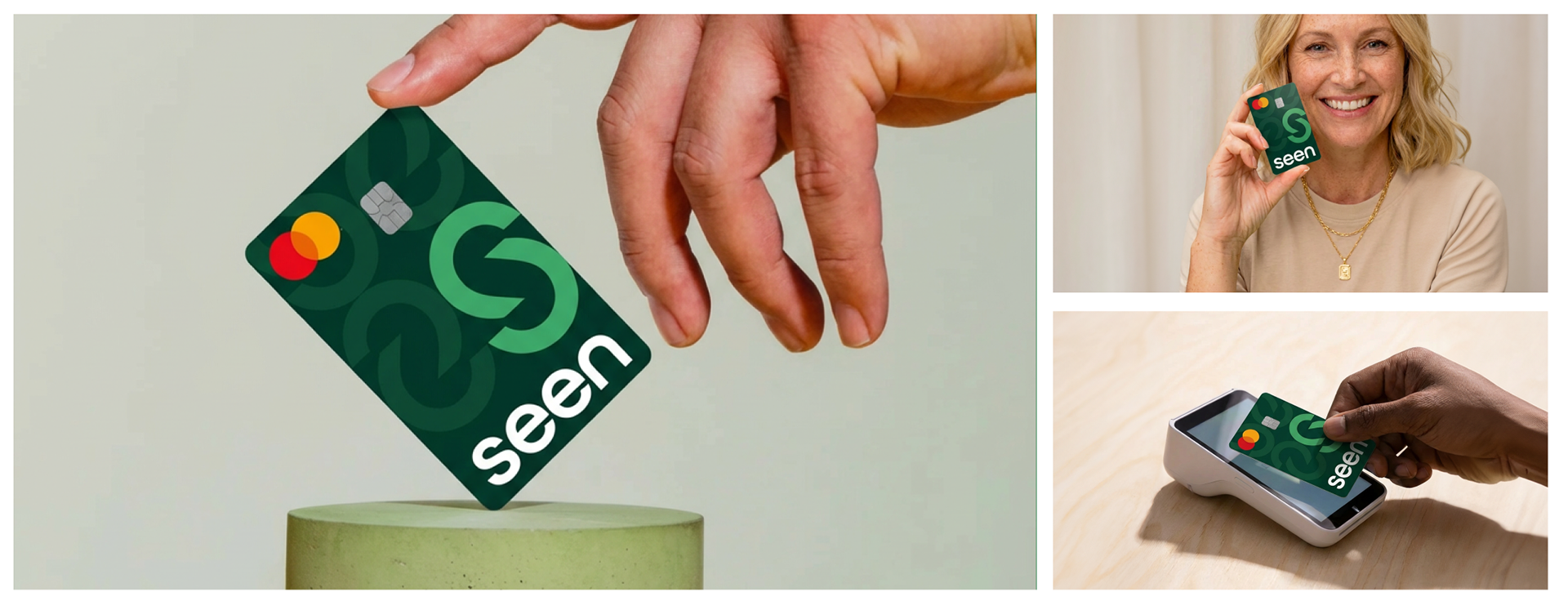
• Updated card art to reflect Seen’s modernized visual language
• Simplified hierarchy and naming exploration underway
• Validated direction through insights testing to ensure audience resonance
• Updated card art to reflect Seen’s modernized visual language
• Simplified hierarchy and naming exploration underway
• Validated direction through insights testing to ensure audience resonance

AI-accelerated mockups
To accelerate exploration and executive alignment, we leveraged generative AI (NanoBanana) to produce high-fidelity mockups of updated card designs and application states.
This allowed us to:
• Rapidly visualize cross-brand cohesion
• Pressure-test design direction before engineering investment
• Shorten iteration cycles during executive review
AI supported velocity while strategic direction remained human-led.
Governance & cross-functional alignment
Because Seen previously lacked mature brand processes, this work required operational infrastructure alongside design updates.
I:
- Scoped and sequenced rollout to prevent scope creep
- Established executive alignment ahead of deployment
- Partnered with Insights to validate creative direction
- Balanced product velocity with brand governance
Rollout is tentatively planned for early Q3 following executive review.
Why this matters
This work positions Snap Finance as a cohesive financial partner, and not a collection of disconnected products.
By integrating Seen into Snap’s ecosystem architecture, we:
- Strengthen Snap’s position as a long-term financial ally for underserved consumers
- Improve visual clarity across product touchpoints
- Create scalable systems for future product expansion
- Reduce internal friction caused by brand ambiguity
This is an active, ongoing architecture effort designed to support Snap’s next phase of growth.